- editorial assistant
- Zoey Chapman
Effective science communication bridges the gap between science and society. This guide outlines practical strategies for turning psychological research into engaging, accessible articles, including topic selection, structuring the article, and responsible presentation of results.
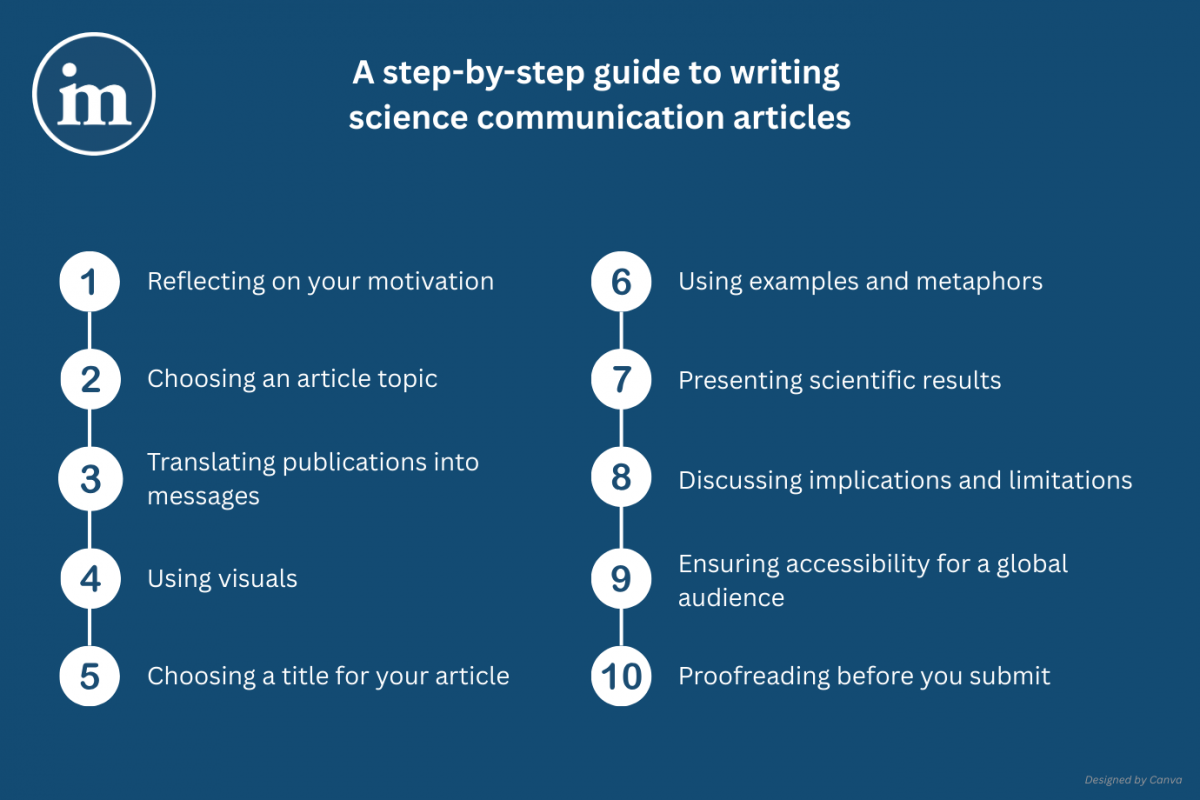
At In-Mind, we aim to help bridge the gap between science and society by making psychological research more accessible. In this article, we discuss ten steps for translating expert knowledge and scientific publications into engaging articles for the public. While some aspects are specific to In-Mind’s format, most tips apply to science communication more broadly.

Step 1: Reflecting on your motivation
We live in a world awash in information, but not all of it is reliable. Therefore, it’s essential for researchers to share scientific knowledge beyond academia. Science communication isn’t just a nice-to-have, it’s a core responsibility of the scientific community. After all, the purpose of science is not only to generate knowledge but also to share it in ways that benefit society. Before you start writing your article, take a moment to reflect on why you want to communicate your work to a broader audience.
- Does your own research have concrete implications for the public or current societal debates?
- Which findings in your field do you find fascinating or personally meaningful?
- Which people or societal groups would you like to exchange knowledge with?

Step 2: Choosing an article topic
Finding the right topic is one of the most important steps when writing about science for the public. Your goal shouldn't be just to share your research, but also to make your article relevant and understandable for people who don't work in your field.
At In-Mind, we encourage authors to think beyond a single paper and instead focus on broader ideas that resonate with a general audience. Your expertise is valuable, but the art of science communication lies in translating it into accessible, engaging content.
What should you write about?
- Your research can inspire your topic, but avoid focusing on one single study, even if it's your own.
- Think about what non-specialists would find engaging and relevant.
- Use your expertise to explain a general theme, not just niche findings.
How broad or narrow should the topic be?
You should aim for a digestible scope: Deep enough to be informative, but not overwhelming. For example, instead of explaining how decisions are made, try to explain why we sometimes make choices that go against our best interest. Try to avoid overly broad topics that turn into a data dump and steer clear of topics so specific they lose general appeal. Imagine explaining your article at a dinner table with friends outside academia. If it sparks curiosity and conversation, you’re on the right track.

Step 3: Translating publications into messages
Writing for a broad audience means rethinking how you present your research. It’s not just about simplifying – it’s about choosing what’s essential and structuring it so people outside your field can follow along.
Which scientific format is similar?
The scope of an In-Mind article is somewhere between an original research article and a scientific review. Like a short review, it can summarize findings from several studies, but it doesn’t need the breadth of a systematic review. Unlike original research, you don’t need to present new data. Instead, you can draw on existing work, and it is often sufficient to cite one strong study to make a point.
Which sections of scientific publications are relevant?
- For the introduction, start with something relatable: an everyday situation or a real-world problem that shows why the topic matters. You can skip the long literature review and set the stage with relevance, not with citations.
- Only mention methods in your article if they help the reader understand the results or trust the findings. You can leave out details that won’t make a difference to comprehension.
- Scientific results should be the core of your article. Try to avoid technical descriptions and too specific details of the results. If possible, combine results from several studies to give a bigger picture to your topic.
- It’s important to discuss the results and to use your expertise to explain what the findings mean and why they matter. Always base your claims on solid evidence, and make it clear when you are speculating.

Step 4: Using visuals
Visualizations can make complex ideas easier to understand. They allow readers to see patterns, relationships, or processes at a glance, and they make longer text sections easier to follow. Using visuals thoughtfully can help your audience grasp the key points without oversimplifying the science. Use visuals that directly illustrate the main point you want to communicate. A simplified graph can show trends or results clearly, while a diagram can explain a process or how elements are connected. But avoid using graphs or figures straight from research papers if they are too technical. Simplify them, and make sure labels, legends, and notes are easy to read. We highly recommend using images that connect your research to real-world examples or everyday experiences. This can make your article more engaging and help the audience see why it matters beyond the lab. Keep in mind that visuals are not just decoration – they help guide understanding, support your argument, and make the information more approachable. Choosing them carefully is as important as the text itself.

Step 5: Choosing a title for your article
A title does more than introduce your text. It sets the frame for what readers can expect and determines whether they will find and read your article. A clear, well-matched title helps make your work accessible to a broad audience.
- Stay close to your article’s scope: The title should reflect what the text covers, not a wider topic or just one small detail.
- Use accessible language: Readers should understand the title before reading the article, so avoid terms that you will define later.
- Keep it informative: Titles that rely on rhetorical questions, theoretical references, or quotations can sound clever but might confuse readers.
- Think internationally: In-Mind reaches a global audience, and pop-cultural references may not translate across regions.
- Clarity before catchiness: A catchy title is welcome if it remains precise, but being informative is the priority.
- Support searchability. Consider which words people might use when looking for your topic online. Short, specific titles help your article to get found more easily.

Step 6: Using examples and metaphors
Examples and metaphors can make your article more engaging and easier to understand. They help readers connect with your ideas and remember them longer, but it's important to keep a few key points in mind when using them.
Use examples effectively
- Choose relatable examples: Pick situations most readers can imagine or recognize.
- Both real or fictive examples can work, but clearly indicate if an example is not real.
- Hook your readers: Starting with a vivid example can draw people in immediately.
Use metaphors wisely
- Use metaphors carefully: They can clarify ideas but shouldn’t be overused.
- Check the fit: Make sure the metaphor works for all aspects of the point you want to make (e.g., stress can be compared to a pressure cooker where tension builds up and interventions function like removing the lid from the pot).
- Note limitations: If a metaphor doesn’t cover certain aspects, consider mentioning this to avoid confusion (e.g., “the brain is a computer” might work for explaining some aspects of cognition but fails to capture emotions or consciousness).
Spin a common thread
- Use one or a few examples and metaphors throughout your article.
- Overarching examples and metaphors can frame your text and be referred back to throughout the article.
- Make sure your examples and metaphors help to convey your key messages.

Step 7: Presenting scientific results
Scientific results can be tricky to communicate, especially when you want to stay scientifically accurate while making findings accessible to a non-expert audience. A few guiding principles can help present findings clearly and responsibly.
Summarize results responsively
- Prioritize patterns: Focus on what several studies collectively show, not one single result.
- Avoid statistical details: Focus on the meaning of findings. Only include numbers when they clarify the takeaway and readers can put them into context.
Stay accurate and transparent
- Use cautious language: Prefer “studies suggest,” “research indicates,” or “evidence points to.”
- Clarify meaning and limits: Explain what conclusions can and cannot be drawn.
- Distinguish correlation from causation: Make clear when findings show associations rather than effects.
Show that science is ever-evolving
- Mention mixed results: Let readers know when studies disagree to reflect scientific nuance.
- Place results within the broader field: In some cases, it is helpful to clarify whether an area is well studied or still in its early stages so readers can understand how robust the evidence is.

Step 8: Discussing implications and limitations
When communicating psychological research, explaining the “So what?” and the “But what?” helps readers understand both the value and the boundaries of scientific findings. Clear implications and transparent limitations make your article more trustworthy and more useful for readers.
So what? How to discuss implications responsibly
- End with key takeaways: A final paragraph or subsection helps readers remember the main points.
- Situate results: Explain how they fit into the broader research landscape.
- Address practical relevance: Indicate who the findings may apply to and under which conditions.
- Be careful with advice: Only suggest practical actions when evidence clearly supports them.
But what? How to communicate limitations transparently
- Be transparent about limitations: Clearly state what the research cannot show.
- Separate facts from interpretation: Keep descriptions of findings distinct from personal conclusions.
- Mention alternative interpretations: Acknowledge when results could be understood differently.
- Avoid exaggeration: Never imply causation when evidence only shows correlation.
- Note contextual limits: Highlight constraints related to population, culture, or specific settings.

Step 9: Ensuring accessibility for a global audience
In-Mind reaches readers around the world, with different cultural backgrounds, educational systems, and levels of prior knowledge. Keeping this diversity in mind helps you write articles that are accessible, relevant, and engaging for a broad audience.
Know your audience
- Keep the international readership in mind from the very beginning: when choosing your topic, selecting examples, and framing explanations.
- Watch out for “default thinking”: legal systems, educational pathways, healthcare structures, holidays, or traditions often differ across countries, cultural spaces, and religions.
- Consider demographic diversity: age groups, gendered experiences, and contextual influences can affect how relatable your examples are.
- Choose references carefully: When a topic is culturally shaped, prioritize studies with diverse or international samples or clearly note when generalizability is limited.
A note for translated articles
If you're translating an article from another In-Mind edition:
- Ensure the topic appeals to an international readership.
- Check whether examples are relatable across backgrounds.
- Review your references: Are they tied to the original language region? If so, mention possible limits.
- Feel free to lightly adapt your article to make it more globally accessible – and add a short note about these adjustments when submitting.

Step 10: Proofreading before you submit
Before submitting your article, a final check can help ensure your text is clear, consistent, and accessible to a broad, non-expert audience.
Final checks before submission
- Review scientific terms: Are all technical terms necessary? If so, introduce and explain them at first mention.
- Check image fit: Make sure images are well integrated into the text and align with the article’s focus or emotional tone.
- Align key elements: Ensure title, main text, snippets, and highlights all convey the same core message.
- Be transparent about perspective: Clearly label opinions, interpretations, or speculations as such, not as established facts.
- Select suitable references: In-Mind articles use fewer references – prioritize key or foundational studies that truly support your claims.
- Optional but helpful: Ask someone outside your field to read the article. Can they follow it and find it engaging?
All images have been created using Canva.